
Updated: Apr 15
Imagine this: you are 5+ years into your home construction journey. A City of Sausalito employee who has been adverse to your property, stonewalling your applications and refusing to respond to emails, trespasses on your property behind a closed and locked construction site, and fabricates a story that a construction worker found human remains on your property. Now imagine that the City refuses to conduct any scientific testing to confirm whether the objects are even human, let alone of Native American origin. The City uses that unverified allegation to halt your construction with a stop-work order that also violates state law, on top of the years of delay it has already inflicted on the project. The Marin County Chief Deputy Coroner, Roger Fielding, says on a recorded call — referring to the actions of the City of Sausalito police and city employees — that "a lot of things went wrong from the very get-go." And three independent experts all verify that your lot is, in fact, NOT an Indian burial ground. The city's unlawful actions cause hundreds of thousands of dollars in damages.
That is, in short, what happened to my family.
This post lays out the events leading up to it. My purpose in sharing it is straightforward: to ensure this is never done to another homeowner and that the individuals responsible are held accountable.
Over the span of three consecutive days last October, more than 10 employees of the City of Sausalito walked onto my locked, fenced, no-trespassing-posted construction site at 426 Pine Street. None of them had a warrant. None had my consent. None gave me notice. We have done everything by the book and even received unanimous approval from both the planning commission and the city council after a neighbor appealed our project. You can view the timeline of our project here. In the months since, the city's explanation for what one of those employees was doing there has changed not once, not twice, but three times — and each new story collapsed under the weight of basic facts the moment it was checked.
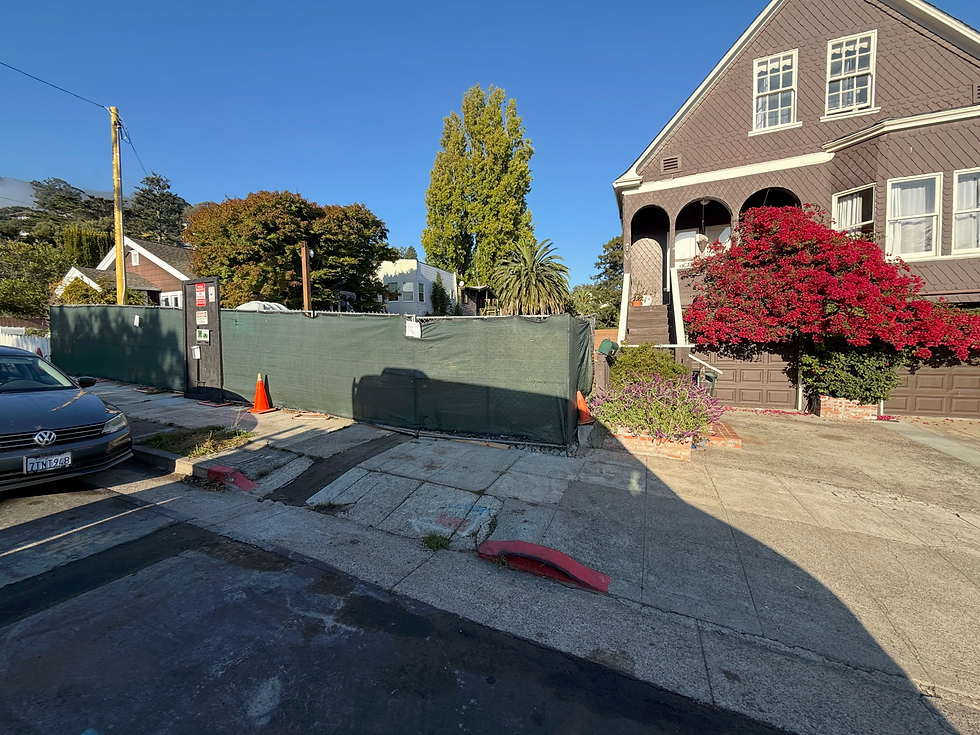
The week in question
Our general contractor works Monday through Thursday on a four-day schedule. The last day any construction crew was on site before this incident was Wednesday, October 9, 2025. From October 10 through October 16, no crew was present, with one exception: our foreman briefly stopped by on October 13 to check site conditions after rain. There was no construction activity on October 13, 14, 15, or 16. The crew was scheduled to resume on Wednesday, October 16 — but the stop-work order issued that afternoon prevented them from doing so. Our general contractor and excavation subcontractor have both confirmed these facts and can provide sworn affidavits.
This timeline matters because it directly contradicts the city's first explanation for what happened. There were no construction workers on site to discover anything.
October 14, 2025 — Code Enforcement Officer Justin Goger Malo. Security cameras recorded Officer Malo on the site for approximately 45 minutes. No warrant. No notice. No consent. The site was clearly posted with a "No Trespassing — Violators Will Be Prosecuted" sign and locked behind a fence with privacy screening.
October 15, 2025, approximately 5:35 p.m. — Principal Planner Matthew Mandich. After business hours. Site still locked. Still posted. Still fenced. He was observed on camera.
October 15, 2025, 11:00 p.m. — A Microsoft Teams meeting. This detail matters. That same night, Mr. Mandich organized a late-night Teams meeting titled "Meeting on CEQA/Tribal Resources" with required attendees Sergio Rudin (City Attorney), Sarah Owsowitz (BBK Law), Brandon Phipps (Assistant City Manager), and Justin Goger Malo. This meeting — about tribal resources, on a project that had no tribal-resources issue — was held mere hours before Mr. Mandich's alleged "discovery" of remains the next day. The timing strongly suggests the finding was coordinated in advance among city officials and outside counsel rather than a spontaneous observation in the field. At this point, we still had not been contacted by anyone in the City of Sausalito.

October 16, 2025 — Four Sausalito Police officers, including Chief Stacie Gregory and Officer Nick White. I happened to be driving by my property and saw the cruisers out front. I asked repeatedly to see a warrant. They couldn't produce one — because there wasn't one. I refused consent, on the record, multiple times. They forced entry anyway. One officer eventually invoked "exigent circumstances" — more than 18 hours after the alleged discovery, with no active threat to anyone or anything. I wanted to keep the site as-is for a proper investigation, which the Sausalito Police completely disregarded — again, as the Marin County Chief Deputy Coroner later stated, "a lot of things went wrong from the get-go."
A stop-work order followed at 1:43 p.m. that day — more than 24 hours after the first entry by Officer Malo. It was the first written notice I received that the city had been on my property at all. A compliant stop-work order is required by law to include instructions for curing the issue at hand. Of course, the City of Sausalito's stop-work order did not comply with that requirement.
The three stories — and why none of them hold up
The most striking part of this whole episode isn't any single entry. It's the way the city's explanation for Mr. Mandich's after-hours visit on October 15 has evolved every time the previous explanation collapsed under basic scrutiny.
Story #1: "Construction workers found something."
The original account, given by Mr. Mandich to Sausalito Police Officer Nick White and reiterated by Officer White to me on the day of the incident, was that human remains on the property "had been identified by construction workers." That same false claim was repeated to Roger Fielding, Chief Deputy Coroner of the Marin County Sheriff's Office. In a recorded phone call, Mr. Fielding explicitly stated he was told the remains were discovered by a construction crew. It was then that he remarked, "A lot of things went wrong from the very get-go."
The catch, as documented above, is that my security footage and the sworn statements of my contractors confirm that no construction workers were on site for the entire week leading up to Mr. Mandich's entry. There were no workers. There was no discovery. The story was, by every available measure, untrue.
Story #2: "He was inspecting a coax cable."
Once the construction-worker story fell apart, the city pivoted. Officer White's written police report (SP 25-453) later claimed that Mr. Mandich was "inspecting a claim of damaged coaxial cables at the construction site of 426 Pine Street."

This story didn't survive contact with a tape measure. The coaxial cable in question runs entirely within the public right-of-way beneath the sidewalk — not under my property. Cable functionality is not within the scope of the Community Development Department's code enforcement responsibilities, and it is certainly not within a principal planner's job description.

It also doesn't survive the geometry of the site. The alleged objects Mr. Mandich claimed to have passively observed were approximately 75 feet away from the broken cable, separated from his vantage point by a fence with a privacy screen, a parked excavator, and a skid steer. It was physically impossible for him to passively "observe" anything at the back of the property from where he claimed to be standing. The line of sight does not exist.

Story #3: "He was inspecting an ADU."
After the coax cable story failed, the City Attorney Sergio Rudin's explanation shifted yet again. The new account, advanced in police report 25-496, was that Mr. Mandich was on site to inspect activity related to the ADU permit (No. B2024-0768).
Look at the photos from the property above. The site is a dirt lot. I'm pretty good at Eye Spy but I don't spy an ADU in the photo below. In fact, there is no structure to inspect whatsoever. The ADU referenced by the permit has not been constructed, and no construction activity was actively underway on October 14, 15, or 16 — the crew had been off-site since October 9 and was not scheduled to return until October 16. A principal planner is also not a building inspector — field inspections are not part of the job — and even if they were, you cannot very well inspect a building that does not exist.
What the experts actually found
While the city was busy generating new explanations, the question of whether 426 Pine Street is actually a Native American burial site was put to qualified independent experts. Three separate sources have now weighed in. None of them supports the city's position. Their own words follow.
Professor Eric Bartelink, forensic anthropologist at CSU Chico
Professor Bartelink was engaged by the Marin County Coroner's Office to evaluate the situation. He noted that the closest recorded archaeological site he could identify was CA-MRN-20 at Strawberry Point — slightly north of our address and over two miles away. In writing, he stated:
"Based on what you are telling me, it seems highly unlikely that your neighborhood is on an old shellmound deposit.... So… [the material] could either be from redeposited material from another location or could have been planted on your property by someone to cause problems."
Two things are worth pulling out of that. First, the closest qualified expert tells us the site is highly unlikely to be a shellmound. Second, the same expert flagged, on his own initiative, the possibility that the objects "could have been planted on your property by someone to cause problems."
PJC & Associates — Geotechnical investigation
In March 2024, as part of our building permit application, PJC & Associates conducted a full geotechnical investigation of the lot. The firm pulled three bore samples, approximately four inches in diameter and roughly eight feet deep, distributed across the property. The investigation concluded that the top approximately 4.5 feet of soil on the lot is fill — offsite material placed there by humans, not native earth. We did pay for the report, but it was produced in 2024, over 18 months before these false allegations arose.
That conclusion is consistent with what we have observed over eight years on the property and with what our construction crew encountered during excavation: bottles, cans, broken glass, concrete, and other modern debris in the top layer. Whatever else is in that fill came from somewhere else — by definition. A fill layer is not a burial site; it is what is hauled in to level a lot for construction, decades ago, from somewhere else entirely.

Alta Archaeological Consulting — the Tribe's own retained firm
Alta Archaeological Consulting was retained not by us, but by the Federated Indians of Graton Rancheria themselves. Their archaeologists Alex DeGeorgey and Sammi Beck conducted a field visit on October 24, 2025, accompanied by FIGR's Tribal Historic Preservation Officer Buffy McQuillen and Lorelle Ross.
In its own October 31, 2025 Historic Properties Treatment Plan (ALTA2025-188), prepared for FIGR, Alta writes plainly:
"the previously mapped site boundary is located north of the parcel"
That is an admission, in writing, by the tribe's own retained archaeology firm: the previously mapped, officially recorded archaeological site boundary is north of our parcel — not at it. That is consistent with what Professor Bartelink told the Marin County Coroner's office. It is consistent with what PJC's geotechnical investigation found. It is consistent with eight years of personal observation on the property.
The Federated Indians of Graton Rancheria
The Native American Heritage Commission designated Mr. Gene Buvelot of FIGR as the Most Likely Descendant under California Public Resources Code § 5097.98. We have engaged with FIGR in good faith throughout, and we have committed in writing to full compliance with § 5097.98, including respectful onsite reinterment of any ancestral remains upon completion of construction. FIGR's role is to ensure cultural protection, and we respect that role.
What FIGR has not asserted, and what no expert has asserted in writing, is that 426 Pine Street is itself a known burial ground or shellmound. That distinction matters: respect for the tribe and respect for the integrity of the cultural-protection process do not require accepting at face value the geographic claim that originated with Mr. Mandich at 11 p.m. on October 15.
What we asked for, and were refused
We formally requested that the Sausalito Police Department, the Marin County Coroner's Office, and FIGR perform scientific testing on the recovered objects to determine, first, whether they were even human, and second, if so, of what origin. All three entities refused. The objects were small enough — ranging from roughly the size of a quarter to a few inches long — that scientific analysis would have been straightforward. It was not done. Imagine that for a moment: a principal planner who has been stonewalling your housing applications decides to trespass on your property, alleges he has found a dead body, and every entity that could verify or refute that allegation through physical or scientific testing simply refuses to do so.
In an on-site video recorded (see below), as Officer Nick White carried the objects out, they appeared heavily coated in soil, which was inconsistent with the heavy rains the area had just experienced that week. That, too, is consistent with the planting hypothesis Professor Bartelink raised on his own initiative.
We have also asked the Sausalito Police to identify who gave them permission to enter our property (see video below), and they have refused to provide an answer. We have filed a government claim, which the city has denied. We are very open to working with the City of Sausalito to resolve this matter, but without proper answers to our questions, supported by evidence or a legal basis, we will have no choice but to file a claim in superior court.
In this video, I ask the Sausalito Chief of Police who gave her permission to enter my property, and she says, "I don't know". This is shocking, given that these unlawful actions resulted in hundreds of thousands of dollars in damages.
If anyone — the city, the police, FIGR, or anyone else — has scientific evidence that contradicts the conclusions of the independent sources above, we welcome it. To date, none has been produced.
The premeditation question
It is worth putting these facts side by side:
An 11:00 p.m. Microsoft Teams meeting titled "Meeting on CEQA/Tribal Resources" the night before the alleged discovery, organized by Mr. Mandich and including City Attorney Sergio Rudin and outside counsel.
A "discovery" the next morning of objects allegedly observed from a position with no line of sight to where they were found.
Mr. Mandich's own statement in police report 25-496 that he previously worked as an archaeologist — meaning he was fully aware of the procedural and financial consequences that placing and reporting alleged Native American remains would inflict on a permitted construction project.
An email from Mr. Mandich to the tribe at 1:23 p.m. on October 16, sent in spite of Chief of Police Stacie Gregory's recorded on-site instruction to "not alert anyone." In that email, Mr. Mandich claimed remains had been discovered "during grading activities" — when no grading activities had taken place on October 13, 14, 15, or 16.
That same email asserted the lot "coincides with the edge of a known shell mound," a representation that is contradicted by every expert who has examined the question.
Reader, you are free to draw your own conclusion about the most plausible explanation for these facts. I will say plainly what I stated to the City Council: based on this evidence, I assert that Mr. Mandich entered my locked property without authority and placed the objects himself, in retaliation for my prior, public call for his termination.
Background: why this happened
This did not happen in a vacuum. For more than three years, I have been trying to expand or convert an approved 428-square-foot accessory dwelling unit (ADU) on our project into a fully compliant junior accessory dwelling unit (JADU) under California Government Code § 66323. Mr. Mandich was the principal planner assigned to the application.
He repeatedly and falsely asserted that "JADUs are not permitted in multifamily zones." The Department of Housing and Community Development had to send an official legal letter (see here) stating that prohibiting JADUs in single-family homes on lots zoned for multi-family use is unlawful. He later asserted that JADUs are subject to local Floor Area Ratio limits. Both positions are in direct conflict with the controlling state law. Both were definitively rebutted by formal written guidance from the California Department of Housing and Community Development (HCD), through Jamie Candelaria, who confirmed that JADUs are permitted on R-3 lots and are not subject to maximum FAR under § 66323.
When their JADU position collapsed, the City Attorney's office attempted to claim the lot exceeded legal lot coverage limits — also demonstrably false. HCD's guidance was repeatedly disregarded. After years of this, in the weeks leading up to the October entries, I publicly called for Mr. Mandich's removal as principal planner for his inability to perform his ministerial duties.
Less than two weeks later, he climbed into my locked property after hours and reported finding what he claimed were Native American remains. The timing was not a coincidence.
Why Matthew Mandich should be terminated
For all of the reasons above, I have formally called for Matthew Mandich's termination as a principal planner for the City of Sausalito.
This is not a reflexive reaction to a single bad day. It is a conclusion based on a sustained pattern of failure to perform the basic functions the job requires:
He cannot keep his story straight. Three different post-hoc explanations for a single after-hours entry — each one collapsing the moment it is checked against the facts — is not a recordkeeping issue. It is a credibility issue, and a principal planner whose statements cannot be relied upon by the police, by the coroner, or by the public has no business in a regulatory role.
He does not respond to emails. Routine, professional correspondence is the most basic communication function of a planning role. Property owners and applicants subject to the city's planning authority are entitled to timely responses. Over the years of work on this project, he has not provided them.
He is not current on California state housing law. California has spent the last several years substantially overhauling housing law — the Housing Accountability Act, the ADU and JADU statutes, SB 9, density bonus, and streamlining laws among them. A principal planner is supposed to know this material cold and apply it correctly. Mr. Mandich's repeated, written misstatements of basic JADU law — corrected by HCD itself — show he does not.
He performed a field inspection that is not within his job description. Principal planners are not building inspectors. They should not climb fences after hours to look at construction sites. If they do, and then fail 3 times to explain why, the city has no business defending their actions.
A city of Sausalito's size cannot afford a principal planner who cannot — or will not — do the basic parts of the job. Continuing to employ Mr. Mandich in this role signals that standards do not apply and puts the city at ongoing legal and reputational risk. I have requested the same with respect to Justin Goger Malo, Brandon Phipps, and Sergio Rudin, all of whom are central to the conduct described above.
The city's actual legal position: an active building permit means unlimited city access, forever, for any reason
This is the part that should worry every homeowner in Sausalito, regardless of how you feel about my family's project.
In police report 25-496, Mr. Mandich states the position plainly: because we have an active building permit, he is entitled to enter the property at any time, for any reason, without notice, without consent, and without a warrant — including for purposes that have nothing to do with the building permit itself. The City Attorney, Sergio Rudin, has taken the same position in defending the city's actions.
The legal hook for that position is a single sentence in the standard inspection clause of our building permit application — signed August 1, 2025. The clause reads, in relevant part:
"I agree to comply with all City ordinances and State laws relating to building construction, and hereby authorize representatives of the City upon the above mentioned property for inspection purposes."
The city's reading of that one sentence is that it operates as a blanket waiver of every Fourth Amendment right the property owner would otherwise have. On their reading, the moment any homeowner in Sausalito pulls a building permit — for an addition, a remodel, an ADU, a re-roof, a deck, anything — they have surrendered the right to be free from warrantless government entry. Forever. On any topic. By any city employee. At any time of day or night.
That is not what the Fourth Amendment says, and it is not what the permit says either. The clause itself limits authorization to "inspection purposes" related to "building construction." It does not authorize entry for unrelated purposes. It does not authorize warrantless after-hours entry by employees who are not building inspectors. It does not waive anyone's constitutional rights.
The U.S. Supreme Court settled the underlying question almost six decades ago. In Camara v. Municipal Court of City and County of San Francisco (1967) 387 U.S. 523, and its companion case See v. City of Seattle (1967) 387 U.S. 541, the Court held that administrative searches by municipal inspectors require a warrant. California Code of Civil Procedure § 1822.50 et seq. lays out exactly how the city can obtain one — by showing cause to a judge. That mechanism exists. It was not used here.
If the city's position is correct, then every homeowner in Sausalito who has ever pulled a building permit has — without their knowledge — signed away their right to be free from warrantless government entry onto their own property. Every permit holder, on this reading, has a city employee's standing invitation to walk in. That is the position City Attorney Sergio Rudin is defending right now.
It is not a defensible position, and it should not become precedent.
What this means for every surrounding property owner
Mr. Mandich's actions have consequences that extend well beyond 426 Pine Street.
The city is attempting to formally report allegations of Native American remains at a location, which feeds into the California Historical Resources Information System and triggers obligations under the California Environmental Quality Act (CEQA) and California Public Resources Code § 5097.98 that attach not just to the subject property but to the surrounding area. Future projects on neighboring lots can no longer rely on the standard CEQA exemptions that small residential projects normally qualify for. A cultural resources review, an archaeological monitor, a tribal monitor, a preservation plan, and the fees that go with all of it may now be on the table for work that previously would have been ministerial.
Those requirements are not theoretical, and they are not cheap. Archaeological monitoring on a single residential project routinely runs into the tens of thousands of dollars, before anything is actually discovered. Tribal monitoring and formal evaluation reports add more on top of that. For homeowners on Pine Street and the adjacent blocks, those costs are now a real possibility for anything more ambitious than a paint job.
Costs of that kind flow into property values. A lot that cannot be meaningfully improved without five- and six-figure compliance spending is worth less than a lot that can.
Fortunately, our family is already through this process. We are building our home. For every neighboring property owner who may want to add a unit or undertake any substantial work in the future, the picture is now materially worse.
If you own a home anywhere near 426 Pine Street, you have Matthew Mandich and the City of Sausalito to thank for that.
Why I'm writing this
I am not writing this to relitigate any single entry. I am writing it because the changing-stories pattern is the part of this story that should worry people. If the city's first instinct, when caught entering a private property without a warrant, is to manufacture a justification — and then a different justification — and then a different justification again — that is a problem for everyone in Sausalito, not just my family.
Neighbors and fellow homeowners deserve to know what happened, what the city has said about it, how those explanations have shifted under examination, and what the actual evidence shows. The facts above are documented in security footage, in the city's own records and emails, in police reports 25-496 and SP 25-453, in expert reports from CSU Chico, PJC & Associates, and Alta Archaeological Consulting, and in a recorded statement from the Marin County Chief Deputy Coroner.
I welcome questions, corrections, and information from anyone with relevant knowledge. For the record, I think it is entirely plausible that the Miwok inhabited this region, and Native American remains certainly exist in parts of Marin County. That possibility is not, however, a license for city employees to trespass, fabricate evidence, and abuse cultural heritage protections to block compliant housing.
---
This post reflects my account as the property owner of 426 Pine Street, supported by security camera footage, expert reports, and communications from the City of Sausalito.
